Maurice Broun
Silent SpringMaurice Broun, curator of Hawk Mountain Sanctuary, gives the book one of its clearest measures of a decline that might otherwise remain hard to see: among the eagles passing through the sanctuary, immature birds have become scarce. By watching and tabulating the migration over more than two decades, Broun turns a seasonal passage into a record of change. His observations do not stand alone as proof of a single cause, but they sharpen the book’s warning that damage to wildlife can accumulate gradually, across landscapes and generations, before it registers as a public crisis.
Hawk Mountain and the Migration
Hawk Mountain is a Pennsylvania mountaintop where eastern ridges converge and migrating birds funnel through a natural bottleneck. Eagles and hawks traveling south from a wide northern territory pass through this corridor, making the sanctuary a vantage point from which change in their numbers and age composition can be observed. Broun’s position there is significant not simply because he sees many birds, but because the geography concentrates their passage and makes sustained comparison possible.
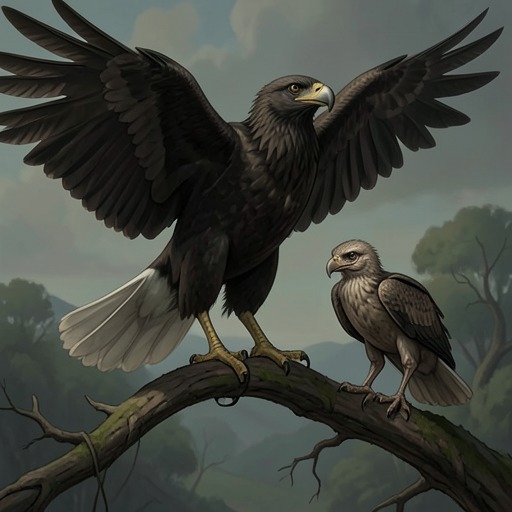
The bald eagle migration reaches its peak in late August and early September. These birds are assumed to be Florida eagles returning to their home territory after spending the summer in the North. Later in autumn and early winter, a few larger eagles pass through; the book describes them as thought to belong to a northern race traveling toward an unknown wintering ground. The seasonal pattern gives Broun’s counts a setting and a rhythm: the birds recur, but their proportions do not remain constant.
A Record of Fewer Young Eagles
During the sanctuary’s first years, from 1935 through 1939, yearlings made up 40 percent of the eagles observed. Their uniformly dark plumage made them easy to identify. In more recent years, Broun found these immature birds increasingly rare. Between 1955 and 1959, they accounted for only 20 percent of the total count—a sharp contrast with the earlier baseline.
The change was especially stark in 1957, when Broun counted only one young eagle for every 32 adults. That ratio gives the general trend a concrete scale: the migration still carried eagles, but the youthful component that might signal successful replacement had dwindled. The book connects this age imbalance to concern about the bald eagle’s future and suggests that the national emblem itself might need reconsideration if the trend continued. Broun’s records make that prospect legible through counts rather than spectacle.
Observation and Ecological Change
Broun’s work belongs to a wider pattern of observation assembled across the book: reports from multiple places and observers are set beside evidence of wildlife loss associated with human interventions. At Hawk Mountain, the strength of the account lies in repeated observation over time. The figures compare one period with another, exposing a gradual shift that a single season could not establish. Broun had observed and tabulated more hawks and eagles than any other American, according to the book, and his long record lends particular weight to the decline in young birds.
The book also places this concern within a broader landscape shaped by efforts to remake nature for human use. Its account of the western sage country describes plants and animals adapted together to harsh conditions, including the pronghorn and sage grouse. Land-management agencies, responding to cattlemen’s demand for more grazing land, sought grassland without sage. The consequences of such interventions could extend beyond their intended targets: in the Bridger National Forest, spraying across roughly 10,000 acres of sage country also killed willows, leaving them shriveled and dying when William O. Douglas visited in 1959. That episode is not presented as the cause of the eagle counts, but it clarifies the book’s larger ecological frame: interventions alter linked habitats, while their costs may emerge beyond the narrow objective that justified them.
A Witness Within a Wider Warning
The book’s account of pesticides likewise emphasizes consequences that can travel through living systems and become visible only after exposure has spread. In its discussion of the fire-ant campaign, it describes wildlife studies that found losses reaching complete destruction in some treated areas; poultry, livestock, and pets were also killed. It further notes that woodcocks wintering in Louisiana and breeding in the North carried residues of fire-ant poisons, with earthworms identified as the route of contamination because the birds feed heavily on them. These cases make the book’s concern larger than any one species or place: poison and habitat disruption can pass beyond their intended targets.
Broun’s role in this argument is that of a careful witness, not a narrator who claims certainty beyond the evidence. His counts reveal a marked reduction in the proportion of young eagles; the book says observations at Hawk Mountain align with findings elsewhere, and presents other reports as corroboration. The result is an accumulating case built from observation, comparison, and warning. A migration bottleneck becomes a kind of ecological register: year after year, the birds pass through, and the missing young expose a change that cannot be dismissed as a passing impression.